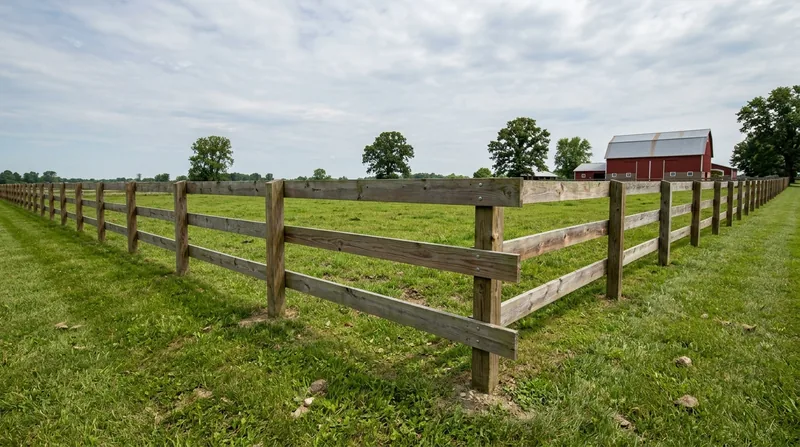




Northwest Ohio's flat terrain and sprawling acreage demand farm fence installation in Toledo that holds against freeze-thaw cycles, heavy wet snow, and the relentless wind off Lake Erie. From Wood County's open fields to the sandy Oak Openings west of the city, ranch properties need fencing that stays plumb through deep winter frost and wet springs that saturate the lake-bed clay. Split rail, no-climb horse fence, field wire, and pipe fencing require posts set deep in concrete, braced corners, and gates sized for trailers and equipment. We install and repair ranch fencing across Wood, Fulton, Ottawa, and Henry counties with straight lines over long flat runs, and the same crew that sets your posts handles your gates and repairs. Call us at (419) 724-2813 for a free estimate, or read on to learn how we size acreage fencing for Toledo's climate and soil.
Why Farm & Ranch Fencing Matters in Toledo and Northwest Ohio
Acreage in and around Toledo sits on poorly drained clay that stays wet through spring and early summer, then freezes solid in winter. Posts set shallow heave out of the ground, and those set in loose soil wash out when the water table rises. A fence that holds for ten years on dry sandy ground may fail in five years on clay without proper depth and concrete footing. Horses, cattle, and equipment also demand stronger bracing than residential privacy fencing, and gates must swing freely and latch securely in all seasons.
- Posts set 3 to 4 feet deep in concrete resist frost heave and stay plumb through freeze-thaw cycles.
- Braced corners and anti-sag bracing on long runs prevent racking and sagging under snow load and wind.
- No-climb horse fence and field wire require proper tension and sturdy hardware to contain animals safely.
- Driveway and equipment gates need heavy-duty hinges, self-closing latches, and posts sized for the load.
- Split rail and pipe fencing blend function with appearance on open land and pasture.
Proper installation and material choice mean your fence works for decades without constant repair.
Key info: Toledo-area farms and ranches in Bowling Green, Perrysburg, and Holland face the same frost and clay challenges. Posts set shallow fail every winter. We set every post to local frost depth with concrete footings that hold through the thaw cycle.
For more information on how freeze-thaw affects fencing in Ohio, see the Ohio State University Extension guidance on soil preparation and post installation.
How We Install Farm & Ranch Fencing in Toledo: Process and Standards
We start every job with a site walk to check soil type, drainage, property lines, and gate locations. On acreage, we run straight lines over flat terrain and set posts at consistent spacing, typically 6 to 8 feet for horse fence and split rail, and 4 to 6 feet for field wire. We call 811 for utility locates before we dig, set posts to the local frost line with concrete, brace corners with diagonal or cross-bracing, and hang gates so they swing freely and latch tight. We also handle fence repair when an existing line needs reinforcement or damage cleanup after a storm.
- We verify the property line with your existing survey and install on the line you identify.
- We call 811 and wait for utility markings before digging any post holes.
- We set posts to frost depth (typically 3.5 to 4 feet in Toledo) with concrete footings.
- We brace corners and long sections with anti-sag hardware to prevent racking under load.
- We hang gates plumb and test latches and hinges before we leave the site.
Every job is built to last through Toledo's wet springs, deep winter freeze, and Lake Erie wind.
Local example: A 40-acre property near Sylvania with a pasture line and a driveway gate gets split rail on the road frontage (for appearance), no-climb horse fence around the pasture (for safety), and a 12-foot cantilever gate at the drive entrance (for equipment access). We set all posts deep in concrete, brace the gate frame, and install a self-closing latch so the gate stays secure whether you're on foot or in a truck.
Farm & Ranch Fencing Methods and Materials for Toledo Acreage
| Approach | Description | Best for |
|---|---|---|
| Split Rail | Wood rails (typically cedar or treated pine) mortised into posts, 2 to 4 rails high, no wire. | Pasture boundaries, road frontage, and decorative perimeter where appearance matters. |
| No-Climb Horse Fence | Welded wire mesh (typically 2x4 or 2x6 openings) attached to posts with galvanized staples or clips, no horizontal rails to entangle legs. | Pastures, corrals, and any enclosure where horses or livestock must be contained safely. |
| Field Wire and Barbed Wire | Galvanized or high-tensile wire strung between posts with tension bands and stretcher bars, typically 4 to 5 strands, barbed or smooth. | Cattle and large livestock containment, boundary lines, and cost-sensitive applications on large acreage. |
| Pipe Fencing | Steel pipe (typically 2 to 2.5 inch diameter) welded or bolted to posts, hot-dip galvanized or powder-coated for corrosion resistance. | High-traffic areas, corrals, equipment yards, and anywhere maximum durability and appearance matter equally. |
Each method handles Toledo's clay, frost, and wind differently. We recommend the right combination for your animals, acreage size, and budget.
Farm & Ranch Fencing Cost in Toledo: What to Expect
Farm and ranch fencing in the Toledo area starts at roughly $12 per linear foot for basic split rail on flat ground with good access. No-climb horse fence runs $15 to $22 per foot depending on wire gauge, mesh size, and post spacing. Field wire and barbed wire run $8 to $14 per foot, while pipe fencing is typically $20 to $30 per foot or more. Gates add $400 to $2,000 depending on width, material, and hardware. The biggest cost drivers are post depth (frost protection adds labor and concrete), soil type (clay and wet ground cost more to dig), acreage (longer runs mean more material and labor), and gate size (a 12-foot equipment gate costs far more than a 4-foot pasture gate).
We recommend getting 2 to 3 estimates from contractors who walk the property and understand local soil and frost conditions. An estimate should include post depth, material grades, bracing, and gate specifications. For a detailed breakdown of our pricing across all services, visit our pricing page.
Real example: A half-mile pasture line (2,640 linear feet) with no-climb horse fence at $18 per foot runs about $47,500 in material and labor, plus a 12-foot driveway gate at $1,200. Add 10 percent for site-specific conditions (wet spots, tree removal, or difficult access), and the total lands near $53,000. That same line in sandy soil with easy access might run $48,000. Soft clay and poor drainage can add 15 to 20 percent.
Farm & Ranch Fencing Near Me: What Toledo Homeowners and Landowners Should Know
Hiring a qualified fence contractor in Toledo starts with checking insurance and understanding how fence work is regulated here. Some municipalities require contractor registration with their building department, while others do not. You should verify permit requirements with your local building department (Toledo, Bowling Green, Perrysburg, or wherever your property sits) before work begins. If your acreage is in an HOA or deed-restricted community, check architectural guidelines for material, height, and color. Always ask the contractor to pull permits if required and to provide a certificate of insurance showing general liability and workers' compensation coverage.
- Confirm that the contractor carries general liability and workers' compensation insurance and can provide a certificate on request.
- Ask whether a permit is required in your jurisdiction and who pulls it (usually the contractor).
- Request 2 to 3 references from recent farm or ranch fencing jobs in your area.
- Verify that the contractor will call 811 for utility locates before digging post holes.
- Confirm gate specifications, post depth, and bracing details in the written estimate.
- Check your HOA or deed restrictions for approved materials, colors, and height limits.
A local contractor who understands Toledo's clay, frost, and wind will build fencing that lasts and performs. Contact us for a free estimate and honest guidance on what your acreage needs.
Farm & Ranch Fencing in Toledo: Pricing Guide
| Service | Price | Details |
|---|---|---|
| Split Rail Fencing | Starting at $12/ft | Cedar or treated pine rails mortised into posts, 2 to 4 rails, posts set deep in concrete for frost protection |
| No-Climb Horse Fence | Starting at $15/ft | Welded wire mesh (2x4 or 2x6 openings) on posts, galvanized staples, proper tension, safe for horses and livestock |
| Field Wire and Barbed Wire | Starting at $8/ft | Galvanized or high-tensile wire, 4 to 5 strands, tension bands and stretcher bars, posts set to frost depth |
| Pipe Fencing | Starting at $20/ft | Steel pipe (2 to 2.5 inch diameter), hot-dip galvanized or powder-coated, welded or bolted to posts, maximum durability |
| Gates and Hardware | $400 to $2,000 | Cantilever or V-track gates, self-closing latches, heavy-duty hinges, size and material drive the final cost |
| Free Estimate | No obligation | We walk your property, verify soil and frost conditions, and provide a detailed written quote within 24 hours |
Indicative pricing, the exact cost depends on square footage, finish, and site access. Free personalized estimate within 24h at (419) 724-2813.


