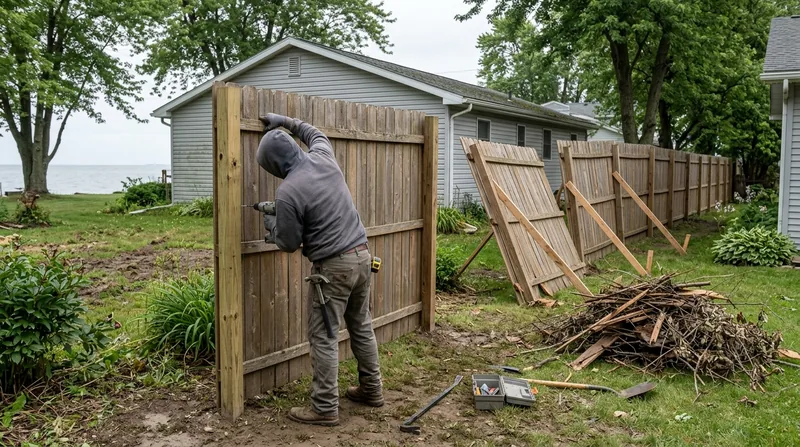




Toledo sits on flat lake-bed clay at the mouth of the Maumee River, where summer derechos, wind off Lake Erie, and heavy wet snow regularly push fences down. After a storm, fallen sections of cedar privacy fence, vinyl panels, or chain link can leave your yard exposed and your property line unclear. Storm damage fence repair in Toledo is not a cosmetic fix, it's urgent work that restores your boundary, your privacy, and your home's weather defense. We assess the damage, document it with photos and a written estimate to help your insurance claim, and rebuild fallen sections the same day or next morning, using the same materials and stronger post installation so the fence holds through the next weather event. Call us at (419) 724-2813 for a free damage assessment, or read on to understand what fails, why, and what it costs to put it right.
Why Storm Damage Matters in Toledo's Flat Lake-Plain Terrain
Toledo's position on the Great Lakes plain means fences face unique stresses. Deep winter frost and freeze-thaw cycles heave posts out of the ground. Wet springs saturate the clay soil, rotting posts at the ground line. Summer thunderstorms and lake-wind gales push panels sideways with force, and heavy wet snow piles against fence sections, adding hundreds of pounds of dead load. Unlike inland cities with better drainage or mountain towns with naturally stable soil, Toledo's flat terrain and poor clay drainage make wind damage fence repair and post failure the two most common calls we take between June and March.
When a fence falls, the problem is rarely the boards or panels, it is almost always the posts. Posts set in tamped soil or shallow concrete fail under lateral load. Posts heaved by frost lift out of their footings. Posts rotted at the ground line snap off. Rebuilding means setting new posts 3 to 4 feet deep in solid concrete, spacing them correctly (typically 6 feet for privacy fence, 8 feet for chain link), and using pressure-treated pine or cedar that can handle the lake-plain climate.
- Posts heaved by freeze-thaw cycles lose their grip and allow panels to rack or shift sideways.
- Saturated clay soil at the ground line rots cedar and untreated pine within 5 to 7 years.
- Wind gusts off Lake Erie push unsupported panels over, especially older fences with single-rail stringers.
- Heavy wet snow in late winter adds lateral load that weak posts cannot resist.
- Galvanized chain link stretched on weak posts sags and loses tension when wind or snow hits.
Each of these failures is preventable with proper post depth, concrete footings, and material choice. When we repair storm damage, we fix the root cause, not just the fallen panel.
Key info: In Toledo and Sylvania, homeowners in 1950s brick ranches and newer subdivisions often have vinyl privacy fence or chain link along the property line. These materials are lighter than cedar but still fail at the post when frost heaves or wind gusts exceed the post's lateral strength. We repair or replace sections depending on what the rest of the fence will support and how much useful life remains in the standing panels.
For more information on how freeze-thaw and soil saturation damage fences, see the City of Toledo's Building and Zoning Services page on building permits and property standards.
How We Repair Storm Damage: Assessment, Documentation, and Rebuild
After a storm, your first step is to call us for a free damage assessment. We arrive within 24 hours, walk your property line, photograph the fallen or damaged sections, and identify why the fence failed. Was it a single post that rotted or heaved, or did the whole line go down? Are the panels salvageable, or do they need replacement? Is the fence racked (twisted) or stepped (panels at different heights)? We document everything and provide a written estimate that includes photos and a clear scope of work, so you can submit it to your insurance company if you choose to file a claim.
Once you approve the estimate, we remove the fallen or damaged sections, extract the old posts (or cut them below grade if they are concrete-set), dig new post holes to the frost line (typically 3 to 4 feet in Toledo), set new pressure-treated pine or cedar posts in concrete, and reinstall the panels or replace them with new material in the same style. For fence blew down situations, we often use anti-sag bracing or doubled stringers on the new section to handle future wind loads better than the original fence did.
- We photograph and document all damage before any work begins, creating a record for your insurance claim.
- We extract fallen posts and dig new holes to proper depth, below the frost line, in solid clay or sand.
- We set all posts in concrete mixed on-site and tamped to remove air pockets, creating a permanent footing.
- We reinstall existing panels if they are sound, or replace them with new cedar, pressure-treated pine, vinyl, or chain link to match your fence.
- We complete most single-section repairs (up to 50 linear feet) in one day, with cleanup included.
The result is a fence that holds through the next storm and the next winter freeze. See our general fence repair page for other common repairs we handle year-round.
Example: A homeowner in Perrysburg called after a June derecho knocked down 60 linear feet of 6-foot cedar privacy fence. The posts had been set in tamped soil only, not concrete. We extracted the old posts, dug new holes 42 inches deep, set pressure-treated pine posts in concrete with 6-foot spacing, and reinstalled the salvageable cedar boards on new stringers with doubled rails for wind resistance. Total time: one full day. The fence has now stood through three more seasons of lake-wind gales without movement.
Storm Damage Repair Methods and When to Use Each
| Repair Method | What It Involves | Best For |
|---|---|---|
| Post Replacement in Concrete | Extract old post, dig to frost line, set new pressure-treated post in concrete footing, reinstall stringers and panels. | Rotted posts, heaved posts, wind-damaged sections where panels are salvageable. Most common repair in Toledo. |
| Panel Replacement with Existing Posts | Remove damaged boards or vinyl panels, leave posts in place if sound, install new panels on existing stringers and posts. | Storm damage to cedar boards or vinyl panels when posts are still solid and concrete footings are intact. |
| Anti-Sag Bracing and Reinforcement | Add diagonal or cross bracing between posts, double stringers, or add corner posts to reduce lateral movement under wind or snow load. | Older fences with single-rail stringers, sections prone to racking, or where wind gusts exceed the original design load. |
| Full Section Replacement | Remove all damaged posts, panels, and stringers; dig new post holes; set new posts in concrete; install new stringers and panels. | Multiple posts heaved or rotted, fallen fence that cannot be salvaged, or where repair cost approaches replacement cost. |
| Fallen Fence Repair (Emergency) | Remove debris, extract posts, set new posts in concrete, reinstall or replace panels, same day or next day, with documentation for insurance. | Immediate aftermath of storm, downed fence blocking access or exposing property, urgent need to restore the fence line. |
Storm Damage Fence Repair Cost in Toledo: What to Expect
The cost of storm damage fence repair depends on how much of the fence failed and why. A single rotted post in a 6-foot privacy fence costs far less to replace than a 100-linear-foot section knocked down by wind. The material you choose also matters: pressure-treated pine is less expensive than cedar; vinyl is more durable but costs more upfront; chain link is fast and affordable for repairs. Labor, equipment access, and soil conditions (clay versus sandy soil) also affect the final price.
We start with a free damage assessment at your property. We photograph the damage, identify the root cause, measure the affected section, and provide a written estimate with a clear scope of work, material choices, and labor. Most homeowners use this estimate to file an insurance claim. If your homeowner's policy covers the damage, you may recover some or all of the repair cost after your deductible. We can help you document the damage for your claim, but the decision to file and the coverage determination rest with your insurance company.
For a detailed pricing guide and examples of common repair costs, see our storm damage fence repair pricing page. Factors that move the cost up include tree damage (if a fallen tree or large branch caused the fence to fail), limited access to the site, hard clay soil that is difficult to dig, and the need to replace multiple posts or long sections of panels.
Storm Damage Fence Repair Near Me: What Toledo Homeowners Should Know When Hiring
When a fence falls, you need a contractor who shows up fast, assesses the damage honestly, and rebuilds it right. Here is what to look for and ask about when you call a fence contractor near Toledo. First, confirm that the contractor is fully insured with general liability and workers' compensation coverage. Ask to see a certificate of insurance. Some jurisdictions require a permit for fence repair or replacement; others do not. The contractor should know your local rules and help you obtain any required permit. Third, ask for references and check them. Ask how long the contractor has been in business and how many storm damage repairs they complete each year. Fourth, get estimates from at least two contractors, and compare the scope of work, materials, and price.
Fifth, if your property is in an HOA community or a historic district, check your deed restrictions or HOA architectural guidelines before approving the estimate. Some HOAs restrict fence height, material, or color, and your repair must comply. We work from the fence line you identify, but a surveyor's determination is the only way to be certain. Finally, if you file an insurance claim, provide your contractor with a copy of your policy and your adjuster's contact information. We can help document the damage and coordinate with your insurance company, but the claim decision rests with your insurer.
- Confirm the contractor is fully insured and can provide a certificate of insurance on request.
- Ask about fence permitting rules in your city or county; the contractor should know local requirements.
- Request references from homeowners whose fences were repaired in the past two years.
- Get written estimates from at least two contractors, comparing scope, materials, and timeline.
- Check your HOA architectural guidelines or deed restrictions before approving any repair or replacement.
- Verify your property line with a licensed land surveyor if you are uncertain where the fence should sit.
Ready to move forward? Call us at (419) 724-2813 or request a free damage assessment online. We respond within 24 hours, no obligation to book.
Storm Damage Fence Repair in Toledo: Pricing Guide
| Service | Price | Details |
|---|---|---|
| Free Damage Assessment | No charge | We photograph damage, identify the cause, measure affected sections, and provide a written estimate for your insurance claim |
| Single Post Replacement | Starting at $350 | Extract old post, dig to frost line, set new pressure-treated post in concrete, reinstall stringers and existing panels |
| Panel Replacement (up to 50 linear feet) | Starting at $800 | Remove damaged cedar, vinyl or chain link panels, reinstall new material on existing posts and stringers if posts are sound |
| Full Section Rebuild (50 to 100 linear feet) | On estimate | Multiple posts, new stringers, new panels, concrete footings. Requires on-site assessment to determine soil conditions and final material cost |
| Emergency Same-Day or Next-Day Repair | Standard rate plus documentation | We prioritize storm damage calls and complete most repairs within 24 hours, with photographs and written estimate for your insurance |
| Travel and Estimates | Included | No separate mileage fee or call-out charge in Toledo and surrounding service areas; free written estimate within 24 hours of your call |
Indicative pricing, the exact cost depends on square footage, finish, and site access. Free personalized estimate within 24h at (419) 724-2813.


